Dopamine Spike → Dopamine Crash
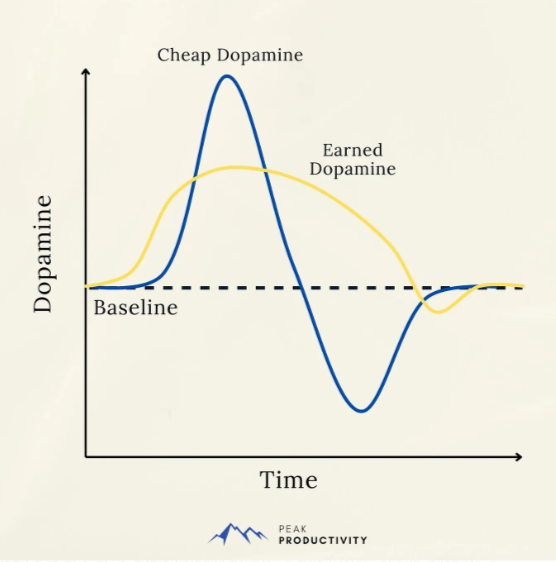
Research shows that after a dopamine spike,
dopamine levels tend to crash and drop below baseline. And the stronger the spike, the stronger the crash.
When dopamine drops below baseline, motivation collapses. Drive disappears. Everything feels harder. This is why people often feel anxious, depressed, restless, or numb after bingeing on
stimulation.
“Prolonged consumption of high-dopamine substances and environments eventually lead to a dopamine deficit state.” — Anna Lembke (author of Dopamine Nation)
This "dopamine deficit state" helps explain why people caught in cycles of addiction and compulsion often feel exhausted, ashamed, and stuck -- not just morally, but neurologically.
The Power of
Dopamine “Fasting”
You may have heard the term "dopamine fasting." It’s become popular, and like many popular ideas, it’s often misunderstood or overhyped.
Strictly speaking,
you can’t "fast" from dopamine. Dopamine is essential to basic functioning. Taking it away would eliminate motivation altogether.
What people usually mean by dopamine fasting is something more practical: intentionally reducing or eliminating exposure to artificial sources of cheap
dopamine.
For some, this looks like moderation -- setting boundaries around screens, social media, or entertainment. For others, especially those struggling with addiction, it looks more like the approach used in recovery settings -- abstinence from a particular source of cheap
dopamine.
Anna Lembke advocates a targeted form of abstinence: a full break from the specific stimulus that has become addictive, for at least a month.
No junk food. No porn. No gaming. No gambling. Completely abstaining from the problematic substance or behavior.
This is paired with support, structure, and tools to manage the anxiety and low mood that often surface during withdrawal.
Whether through moderation or abstinence, the principle is the same: Regularly stepping away from cheap
dopamine allows the brain’s reward system to reset.
If we don’t do this, earned dopamine loses its power. Motivation dries up. Long-term goals feel unreachable. Life becomes reactive rather than intentional.
But when we create space from artificial stimulation, something important happens: our motivation and joy starts to build back up. Effort starts to feel meaningful again. We recover the capacity to live with purpose rather than compulsion.
ACTION STEP
Getting a new insight or reminder is one thing. But what really matters is what we DO with
the things we know. Here's how you can take action on this ... today:
Take ten minutes and do a simple “dopamine audit.” Here's how:
Grab a piece of paper or open a note on your phone and answer these three questions honestly:
- What is my most common source of cheap dopamine right now? Be specific. Social media scrolling. Porn. Junk food. Gaming. Streaming. Online shopping. News consumption. Whatever it is, name the one that shows up most often.
- When do I usually turn to it? Late at night? When I’m bored? Stressed? Lonely? Avoiding something? See if you can detect the patterns. Identify what surrounds and precedes your usage.
- What is one small boundary I could try for the next 24 hours? Not a lifetime commitment. Just one day. It might be: no scrolling after 8pm, no junk food tonight,
no gaming before bed, no porn today, no background TV. Choose one clear, doable limit.
Then do one small thing that supports earned dopamine instead: take a short walk, tidy one room, read a few pages of something meaningful, pray, stretch, or work on a task you’ve been avoiding.
This one small step starts the process of retraining your brain to tolerate less stimulation and rediscover satisfaction in effort, presence, and progress.