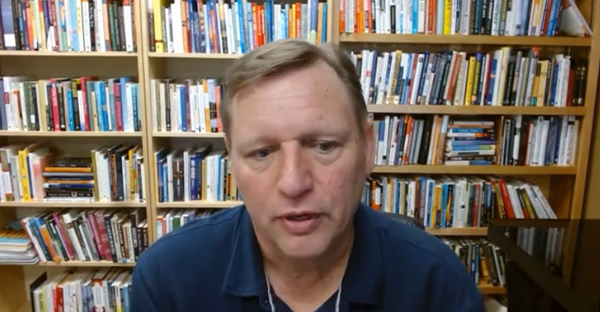
This video was recorded as a follow-up to me being one of the speakers at The Trauma Recovery Summit in 2022. As sometimes happens, the person who ran the summit — Sarah Brassard — went in a different career direction after doing this summit and follow up workshops. So this interview -- along with
the other followups she did -- never got promoted or went anywhere. Likewise, the Trauma Recovery Summit itself is no longer available online. Bummer, right? I had forgotten about it all this, until I came across this video on youtube a few days ago.
I’m sharing it with you because you might find something helpful in it. I'm including the
transcript of the video below, if you'd rather just read it. We talk about my own journey in recovery and the work I do, and there could be some good takeaways for you as you think about your own journey of healing. The video is 32 minutes long.
A couple things to note before listening to the
interview -- or reading the transcript below:
- Note that the original audience for this interview is not Christian, so I talk about spiritual issues from a pretty broad perspective. This is my attempt to reach out to people beyond the church and talk about the importance of our spiritual lives, and the role of spiritual issues in recovery in recovery from addiction and other mental health issues.
- I
misspoke about the timeline of my story. I realized as I listened to the intervew that at one point I the years wrong. I said that I left my role as pastor at Bridgewood Church and started working with Faithful and True in 2011 … it was acutally in 2006. I corrected that in the transcript below. 2011 is actually when I went back into church ministry (while still working with Faithful and True part time.)
VIDEO INTERVIEW TRANSCRIPT
Sarah Brassard: I'm really happy to be back with you, Mark. As we were talking about just moments ago before we started recording, we
had a really interesting conversation for the Trauma Recovery Summit. It's always exciting for me to get back in touch with those of you that I feel a strong connection to. Your mission is one that really interests me, and I have a lot of curiosity about our conversation today. I'm really excited for our audience to listen to this interview.
We are going to be talking about the emotional and spiritual journey to heal anxiety, depression, and addiction. Our guest today is Mark Brower. Mark is a spiritual teacher, a writer, and a speaker. He currently serves as the pastor of Bethel Church in Princeton, Minnesota. He is the director of Renew Resources, which provides teaching, retreats, and support for leaders who struggle with anxiety, depression, or addiction. Mark is also the creator and director of the Renewed Man
Community, a 90-day boot camp for people who struggle with sexual compulsion or addiction. Mark has written three books, including Rise Above: Overcoming Discouragement in Challenging Times and Leaving Your Mark Without Losing Your Mind. Mark, I'm so happy to be with you today.
Mark Brower:
Thanks! I'm excited to be here and looking forward to our conversation.
Sarah: I would love it if you could give our listeners a little background on what got you interested in these issues of anxiety, depression, and addiction.
Mark: Like so many of us, it's twofold — it's dealing with things in your own life, and then in the process of dealing with them, wanting to help others go through the same kind of thing. I went through seminary after college and then launched into church ministry pretty much right away. From an early age I was connecting with people as a pastor and
spiritual teacher, and pretty quickly saw all the needs people brought with them.
The other part of it is that even though I considered myself a pretty laid-back, chill person growing up, once I got married, had kids, and started pastoring — actually starting a new church, what we call a church plant, in Austin, Texas — I really started
feeling the pressure. What I came to understand is that I didn't come into adulthood with the coping skills I needed to deal with all the stress and demands that were on me. I struggled with anxiety and with addiction of sorts. I think of addiction almost like a continuum — we're all somewhere on the spectrum.
Over time I started that
church in Austin, Texas, was there for a number of years, then moved to Minneapolis, Minnesota and started a church there. This all came to a head for me in 2006 with a burnout and addiction experience, which led to me leaving the church and going to work with a psychologist who ran a program focused on addiction and recovery. I started working with him and ultimately became the director of training for his organization. His name is Mark Laaser. That began a professional and ministry journey for
me — that's where I started writing books and leading seminars. Now I've gone back into church work, doing that alongside these other efforts that are really tied to what I do as a pastor, but also serving people outside of my local church.
Sarah: I'd love to drop into this a little bit,
because I think you've touched on things many people will understand. You talked about burnout and addiction together, and you mentioned feeling ill-equipped for the pressure placed upon you — that you didn't have the coping skills. Do you believe that we create ways of coping that can lead to addiction?
Mark: Absolutely. I came across this somewhere — someone talked about one of the key goals for parents being to help their kids learn how to self-soothe, to deal with distress in a healthy way. I had a good family, my parents were together, but it was not a perfect family. I was the youngest, and there's different terminology for different kinds of upbringings. I was the classic "Lost Child" — I was on my own a lot and learned to take care of myself by isolating. I would ride my
motorcycle and do things on my own.
So rather than learning how to deal with things in a healthy way, I learned to deal with them by putting up a front for others and shutting down. I also grew up as someone who liked to joke around and make people laugh, which became people-pleasing and codependency. I really wanted people to like me. I
wanted everyone to be happy and have a good time. When you're leading an organization or a community, if that's what brings you comfort — if you're not okay unless everyone else is okay — you're going to be stressed out all the time. And I was, because there's always someone who's unhappy about something in a church, always conflict of some kind. I hadn't learned how to deal with that.
These are things unique to my own situation -- being a pastor -- but hopefully other people can relate to them. The biggest turning point for me was really connecting to the teaching I first heard through the recovery and twelve-step community, and then came to an even deeper understanding of through the study of Stoic philosophy. The whole Stoic emphasis is on getting clear about what you can control versus what is beyond your ability to
control. In recovery they talk about it through the Serenity Prayer: "Grant me, God, the serenity to accept the things I cannot change." As simple as that distinction is, it has become huge in terms of my ability to manage stress, manage expectations, and manage the projections that people put on me — most of which are outside of my control. That allows me to live more at peace.
Going back to your question about how this relates to addiction: if I'm having a hard time being okay with whatever is going on around me, one of the ways that plays out is high levels of anxiety. Then you're going to look for other ways to soothe and comfort yourself — to distract yourself — which is where turning to food, sex, gambling, alcohol, drugs, or whatever else comes in. I really see these as very closely tied together. Therapists call
these co-occurring disorders. There's almost always something giving rise to the addiction.
Sarah: I really appreciate your sharing at that level. I know this is some of the most vulnerable work we do as teachers, and I want to honor you for it — your vulnerability is really the opportunity for
people to hear and feel what it's like to walk this path of healing. One thing I'm very curious about: would you say you weren't really heard or seen as a child? You mentioned the "Lost Child" — would that be accurate?
Mark: Yeah, probably fairly accurate. I really like to take the blame off
parents, because it's all just life and how life works. People are overworked, or circumstances intervene — those are just the realities of life. So let's try to get the blame game out of it. But within that, yes — what the Lost Child is often looking for is attention, affirmation, and validation. That plays out in different ways. Some people act out to get it. Some become the class clown. Some pursue it through achievement.
That's kind of what I did — I went into achiever mode, which is fine on one level. But what you discover as you get older is that no matter what you achieve, it doesn't satisfy, because it's based on a deep inner need that nothing external is going to meet. That's where the issue of healing comes in.
Anxiety, depression, and addiction — in some ways they seem like random, related mental health disorders, but they're probably the top three leading mental health issues in our society today. Therapists and psychiatrists will say that anxiety and depression are often two sides of the same coin — they frequently occur together. If you're running on anxiety and adrenaline, pushing yourself hard, you'll often feel depleted and then depressed. And
depression also comes when people have spent years trying to receive whatever they felt they needed in terms of validation, only to find it's never enough.
There's a saying about money and happiness: the poor are happier than the rich, because the poor still think money can buy happiness — but the rich know better. Beware of getting
the thing you always thought you wanted, because when you get it, you realize it doesn't fully satisfy.
Sarah: As someone who looks at life holistically, I'm curious — for those in our audience who are recognizing these characteristics in their own life, how do these things show up? For me it
was physical — a physical response that woke me up and made me realize I can't do life like this anymore. Can you speak to the ways people might arrive at that moment of recognition?
Mark: It shows up in a variety of ways. For some people it's a continual sense of meaninglessness or emptiness
and you try to fill it by doing all kinds of things — building a new house, getting a different job, moving from one thing to another — and at a certain point, when you stop, you realize something's not working. The modern world makes it very easy to find distractions, whether that's addictive substances, addictive behaviors, or simply media, binge-watching television, or video games.
But every now and then we hit a point where we're lying in bed at night and there's nowhere left to escape or distract ourselves, and we have to face whatever is there. For some people it's a dramatic burnout — something very physical. For others, it's having to acknowledge that their use of something has become an unhealthy addiction, one that is damaging to them. And then the journey of recovery from that addiction forces them to deal with whatever
is going on beneath the surface.
I've done quite a bit of work with people in addiction recovery, and we have a saying — a bit of a coarse one, but I'll share it: "It's hard to stay sober if your life sucks." People will try really hard to stop a behavior. But if they don't work to fix whatever isn't working in their lives, it won't
work.
It's like swimming while trying to hold a beach ball underwater — you can do it if that's all you focus on, but the minute you get tired or distracted, you'll let go and it will pop back up. That's why long-term recovery has to involve looking at these deeper factors. I suspect the same is true for anxiety and depression —
long-term recovery is not simply about managing symptoms. It's about facing what isn't working in your life. And I believe the spiritual and existential questions of life are part of that picture for many people. That's not all of it, but it is part of the healing journey.
Sarah: I see anxiety,
depression, and addiction as brothers and sisters — not even cousins. I'm really curious about what you just said regarding spiritual beliefs. What role does faith play in the healing journey?
Mark: The most important thing to say first — because our listeners come from a variety of spiritual
backgrounds, and some may not embrace spirituality at all — is to direct people's attention to the insights of Carl Jung, one of the founders of modern psychology. He was very aware of this. He once said that of all the people he had treated over the age of thirty-five, there was not one whose issue did not ultimately come down to developing a spiritual or religious outlook on life.
In other words, for every one of them, it came down to a sense of meaninglessness — to whether they had somehow come to terms with what he called "issues of ultimate concern," some kind of religious or spiritual outlook, some connection to a higher power, something greater than themselves. He said that without that clarity, people will focus their energies on things that ultimately leave them unsatisfied or even more stressed out.
So the first point is that all human beings need to find some way of connecting to something bigger than themselves — otherwise all we have left are what I would call false substitutes for meaning and purpose. And again, beware of actually catching the thing you've been chasing, because you'll find it doesn't satisfy either.
I come from a Christian background and am a committed Christian. I believe Christianity is a way that many people throughout history have been able to find meaningful answers to those spiritual and existential questions — a way of understanding your place in the world and your connection to something greater than yourself.
One more thing on this: alongside the spiritual connection, relational connection is equally vital. Connection to community, to a tribe of some kind. Whatever your views on history, our ancestors for countless generations existed as hunter-gatherer tribes. It's built into our DNA to find comfort, meaning, and solace in close community — a family
clan and the people who constituted a tribe. In the modern world many of us are very mobile, we move around, we may not have a strong connection to family, and we are often disconnected from a meaningful, close-knit community. That's deeply dangerous. A healthy spiritual community — in my case, a Christian community — can be a real healing place.
Sarah: I think it's important to name here that this disconnection we talk about is not only from others but, really primarily, from ourselves — in the process of being depressed, anxious, or addicted. When you're chasing anything to soothe yourself, you're often blaming others for not filling you up or giving you the feeling you yearned for. Is that consistent with your belief, Mark?
Mark: For sure. One way of saying it is that we need a healthy awareness of and connection to our own true self, a healthy and meaningful connection to others — to a tribe — and a healthy, meaningful connection to something beyond us, to the divine. If any of those are lacking, we're in real trouble.
Sarah: As we begin to wrap up, what are some of the most important things you would like to tell our audience?
Mark: One thing I want to
bring into this conversation that we haven't touched on yet is the importance of physical well-being as part of the recovery journey from addiction, depression, and anxiety. In my program called the Renewed Man, we focus on different keys to find lasting recovery -- which requires mental, emotional, and spiritual health -- and one of these keys is developing physical well-being.
I want to mention an author whose work I think is really significant. His name is Chris Palmer. He's a psychiatrist who leads the post-doctoral and continuing education program at Harvard University, and his belief is that there is a physical, metabolic issue underlying mental disorders. His book is called Brain Energy, and his understanding of the problems that develop has to do with the mitochondria.
One of the ways I've seen this play out in my own life, and that many people testify to, is that when they change their diet — particularly reducing sugar and highly processed foods — they experience a mental shift: better mood, more energy, clearer thinking, and even a lessening of depression and anxiety symptoms. There is something real in the connection between our
physical life and our emotional and mental life.
The same is true of physical movement. In the men's group I run, we have a saying: I exercise because it makes a difference in my mental health. If it also does something for my physical life, that's a bonus. The research on that connection is really strong now.
So in terms of the most effective methods for moving through depression, anxiety, and addiction, I would put community first. Second would be coming to clarity and peace about your spiritual connection — your place in the world, your connection to God, to the divine. And third would be physical well-being. Personal connections often actually help us strengthen our
spiritual connection, and physical well-being may be uniquely important right now because our food supply is significantly compromised and many of us live very sedentary lives — both of which are damaging not only physically but also mentally and emotionally.
Sarah: Mark, thank you so much for
talking with us. It has been a truly enlightening conversation. For our audience, let me recap what we explored today: the various components of healing; the role of faith and belief in the process; how to approach these issues respectfully; what some of the biggest challenges to healing are; how to create a safe and supportive environment; and some of the most effective methods for dealing with these issues, including how spiritual understanding can help others heal. You'll find all of Mark's
information in our show notes. We really appreciate you being here — let's do it again soon.
Mark: It's always a pleasure. Thank you. I really appreciated the chance to talk, and I'm looking forward to a time when I get to interview you, Sarah, about all that you've learned and all that you do
in your work.